
I was always drawn to cemeteries for the peculiar way people are remembered on their tomb stone, leaving etched hints of what they were like in life. The smaller the grave marker, the more humble a person's life must have been. I remember visiting the Old Russian
Molokan Cemetery on 2nd Street in Los Angeles and looking in awe at the pointy wood grave markers dating back to the late 1800s, many with no names and the markers being no taller than twelve inches from the ground.
As an adult, my interest in them has not diminished. When I
travel, if there is a cemetery nearby, I go and photograph the way people bury
their loved ones and compare how society influence and designates the type of
grave marker a loved one should display. As you walk through Montjuic Cemetery, here in Barcelona, social classes are apparent by the size and money that was spent hiring
renowned architects and artists to sculpt pretentious tomb stones and mausoleums.
There is beauty in cemeteries often ignored; death being the obvious reason no
artistic significance is usually associated with them by the general population. It is not the first place one contemplates to view sculptures or to seek artistic inspiration.
However, there is genuine interest to discover who sculpted the
magnificent sculptures that decorate sepulchres and mausoleums. Some mausoleums look like mini cathedrals and ostentation can be seen by their size and height reaching up towards the heavens. There are masses of cut, chiseled, and formed stone houses with colorfully stained windows and intricate iron work now eroded.
This morning I went to Montjuic Cemetery for a guided tour
that began at 11.15 am in Spanish. I thought that there would be as few as 8-10
people. What a surprise to arrive and find a group of about 30 of us ready to
discover works by Eusebio Arnau, Josep Llimona, and other popular Catalan sculptors
of the 20th century. The tour explained the history of Barcelona's two cemeteries, Poblenou the oldest and Montjuic the newest, and the population growth that led to the building of a new cemetery terraced in the Montjuic rocky hillside. The Montjuic quarry made it possible to build and give the cemetery its characteristic look by quarrying stone from it. Although the cemetery is for poor and rich alike, you can easily see walking through the cemetery the social stratification, with bourgeois families building immense mausoleums and the poor occupying small walled crypts.
The tour ended at the Fossar de la Pedrera, a common mass grave where 4,000 people were buried after being executed by Franco's fascist regime. The Quarry Grave is a tragic place when you look at the large grassed expanse of land and imagine the ghastliness committed in a lone part of Montjuic. A quiet sadness permeates these solemn grounds in remembrance of all those who perished during the civil war and denied a decent burial by family members. The Fossar de la Pedrera is on the south side of the cemetery and worth visiting to observe the Memorials of people executed there during the Spanish Civil War and other small memorials of diverse groups who died supporting the Republican cause. The contrast with the Fossar de la Pedrera and the rest of Montjuic Cemetery is quietly perceptible. There you will not find ostentatiousness.
 |
| I swear that man looks like Edgar Allen Poe. |

 |
| The top of this sepulchre is by Rossend Nobas I Ballbé in the realism style. |
 |
| Alpha symbol, the beginning of things... |
 |
| and Omega the end. |


 |
| Àngel Guimera, a popular writer born in the Canary Islands, but raised in Catalonia. |
 |
| Pyramid inspired crypt. |
 |
| Mason symbol |
 |
| Owl, guardians of the night with Samson symbol. |
 |
| Seraphim angels with Egyptian influences. The original design of this mausoleum had religious figures and not the pseudo Egyptian design with Seraphim angels. One angel holds a trumpet and the other a funeral wreath. Catholic crosses at the top of their heads reaffirm Christian faith. |


 |
| Bronze doors. |
 |
| 1894 Neogothic mausoleum by Eusebio Arnau I Mascort. |
 |
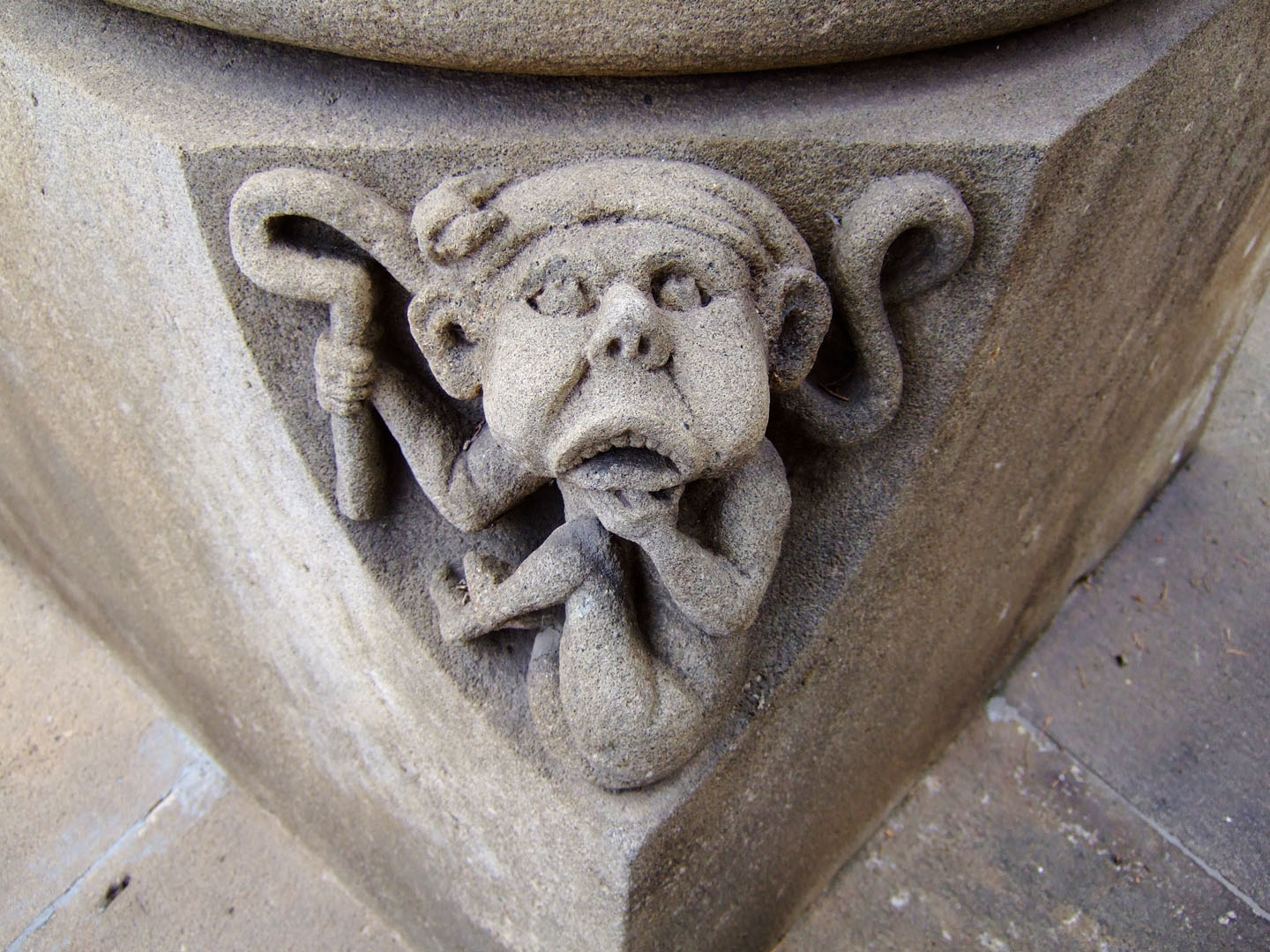
| Recurring motif throughout the cemetery. |


 |
| Gargoyles laughing metaphorically at people who have not reached the spiritual plane. |


 |
| Greek influence |
 |
| Frieze |


 |
| More mason symbols. |


 |
| 1894 Neoegyptian mausoleum sculpted by Pau Deulofeu I Palet and designed by architect Leandre Albbareda who designed Montjuic. |

 |
| Mausoleum by Eusebio Arnau. |

 |
| 1913-1914 Modernism by Antoni Pujol |
 |
| A family cleans the resting place of a loved one. |
 |
| Simple wall crypts. |


 |
| "It is not good-bye forever, only a good-bye for an instant." |
 |
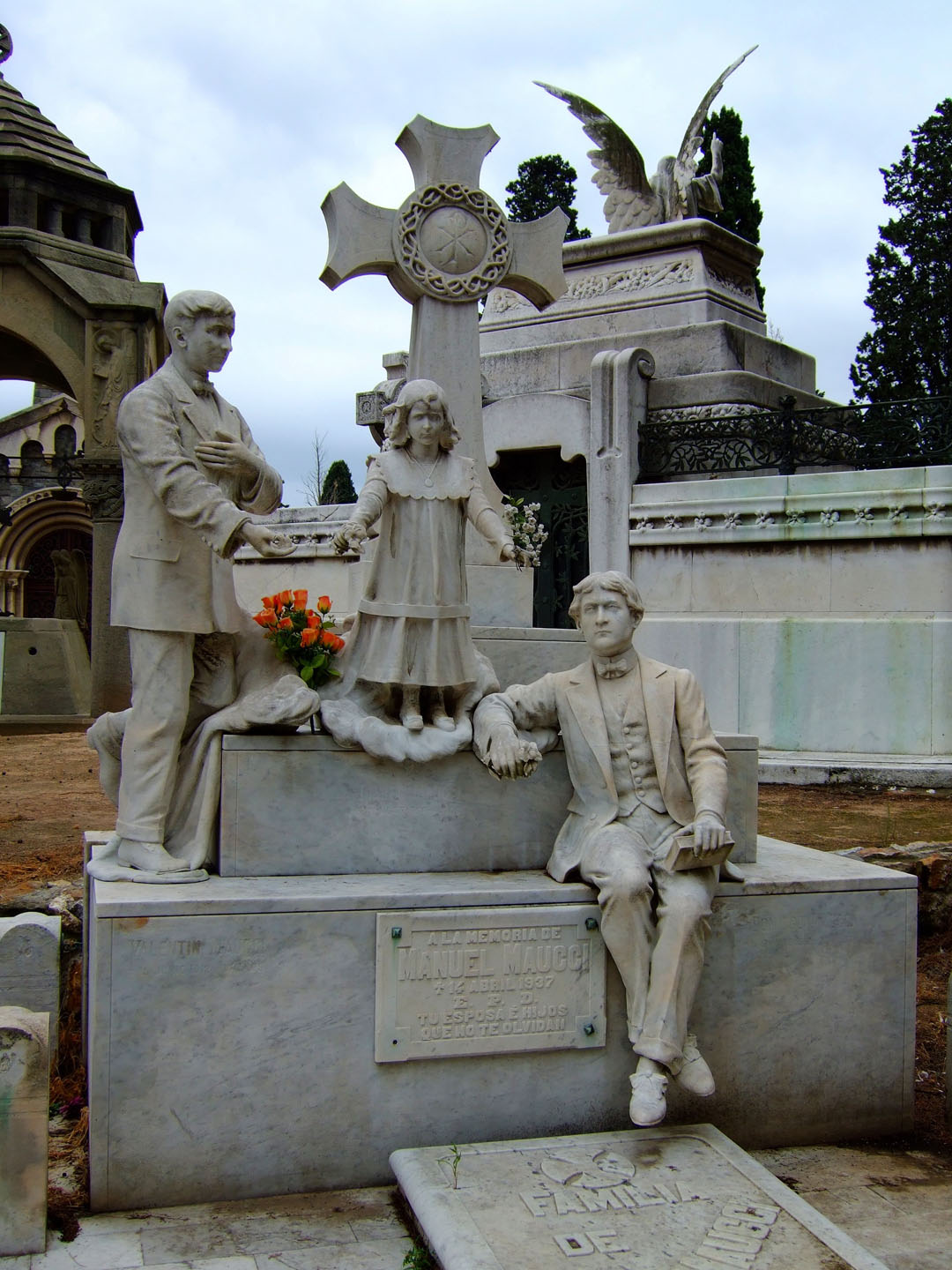
| 1909-191 Neoclassicism by Martinez I Fortuny |

 |
| Mausoleum built in 1906-07, Modernism by Rafael Atache |
 |
| 1903-1904 Modernism by Simó Cordomí |
 |
| "I am the resurrection and the life." |
 |
| 1889 Neoegyptian by Manuel Fuxà, I Leal, and Josep Campeny |
 |
| Same port the Romans used--did I mention the cemetery is in front of the Barcelona Port? Yes, the buried here have ocean front views. |
 |
| bench |
 |
| The characteristic piled stones that give Montjuic its look. |
 |
| The new tomb stones of black polished marble; these angels lack the majestic presence with the ones observed in other tombs. |

 |
| Names of fallen people and believed to be buried in the mass burial grave here in Montjuic during the Spanish Civil War. |
 |
| Fossar de la Pedrera, mass burial ground for Republicans executed during the Spanish Civil War at Montjuic by the Franco regime. |
 |
| Symbolic resting place of Lluís Companys, President of Catalonia during the Spanish Civil War. He was executed at Montjuic Castle during Francisco Franco's dictatorship by the fascist Spanish army. |
 |
| This is the cliff side where many were executed, a very remote area out of view from the Barcelonans. |

 |
| In honor of the Jewish volunteers that helped Republicans fight against Franco. |


